Best HVAC Systems for Florida Homes

Table of Contents
Why HVAC Selection Matters in Florida
Quick Comparison: Top HVAC Systems for Florida Homes
High SEER2 Rating Benefits and Energy Efficiency
Corrosion-Resistant HVAC Coils for Coastal Durability
Top HVAC Systems Ranked for Florida Performance Carrier Infinity 26 Air Conditioner Lennox XC25 Variable-Capacity Air Conditioner Trane XV20i TruComfort Variable Speed Heat Pump Rheem Prestige Series RP20 Heat Pump Goodman GSXC18 Air Conditioner Mitsubishi Electric M-Series Ductless Mini-Splits
Carrier Infinity 26 Air Conditioner
Lennox XC25 Variable-Capacity Air Conditioner
Trane XV20i TruComfort Variable Speed Heat Pump
Rheem Prestige Series RP20 Heat Pump
Goodman GSXC18 Air Conditioner
Mitsubishi Electric M-Series Ductless Mini-Splits
HVAC Maintenance for Coastal Homes
Key Factors: Load Calculations and System Sizing
Conclusion
Last Updated: August 25, 2026
Why HVAC Selection Matters in Florida
Florida's intense heat, high humidity, salt-air corrosion, and hurricane-force winds create unique HVAC challenges. Standard systems fail to manage humidity efficiently, leaving homes sticky even at 72 degrees, while coastal salt spray attacks aluminum coils, causing premature failure. The best HVAC systems for Florida manage humidity precisely, resist corrosion, and deliver energy efficiency that lowers utility bills. This guide covers energy efficiency ratings, corrosion resistance, and how to evaluate systems for your specific needs while avoiding costly mistakes.
Quick Comparison: Top HVAC Systems for Florida Homes
System | Type | Key Advantage | Best For |
Carrier Infinity 26 | Variable-speed AC | Highest SEER2 (26), salt-resistant engineering | Maximum efficiency, coastal homes |
Lennox XC25 | Variable-capacity AC | Quantum coil (salt-resistant), 26 SEER2 | Coastal durability with premium efficiency |
Trane XV20i | Variable-speed heat pump | 20 SEER2, excellent humidity control | Year-round comfort, humidity management |
Rheem Prestige RP20 | Variable-speed heat pump | 20 SEER2, balanced value | Budget-conscious, reliable performance |
Goodman GSXC18 | Two-stage AC | Lifetime compressor warranty, affordable | Cost-conscious homeowners, non-coastal areas |
Mitsubishi M-Series | Ductless mini-splits | Zone control, flexible installation | Homes without ductwork, room additions |
High SEER2 Rating Benefits and Energy Efficiency
SEER2 (Seasonal Energy Efficiency Ratio 2) measures cooling efficiency using updated testing standards reflecting real-world Florida conditions. A 26 SEER2 system consumes roughly 40% less electricity than a standard 13 SEER2 unit annually. In Florida's perpetual cooling season, a homeowner operating 26 SEER2 versus 16 SEER2 might save $40-60 monthly, totaling $7,200 to $10,800 over a 15-year lifespan.
Variable-speed compressors enable high SEER2 ratings by adjusting output continuously to match demand instead of cycling on and off. Running at partial capacity longer removes more moisture than full-capacity short bursts, providing superior humidity control.
Pro Tip When comparing SEER2 ratings, the difference between 20 and 26 SEER2 is significant (30% more efficient), but a well-sized 20 SEER2 system often outperforms an oversized 26 SEER2 unit. Energy Star certification indicates SEER2 ratings of 20 or higher with demonstrated durability in demanding climates.
Corrosion-Resistant HVAC Coils for Coastal Durability
Salt air corrodes traditional aluminum coils within 5-8 years in coastal environments (peer-reviewed research). Once corrosion penetrates coil tubing, refrigerant leaks and system failure follow. The Lennox XC25 uses an all-aluminum Quantum coil with enhanced corrosion resistance through specialized coating. Carrier's Infinity series and Trane systems incorporate welded aluminum construction and protective treatments. Zinc cladding and epoxy-based coatings prevent salt spray from contacting the coil directly.
Watch Out Budget air conditioners like the Goodman GSXC18 use lighter-gauge aluminum and less corrosion-resistant paint, showing visible rust within 3-4 years in coastal areas ([peer-reviewed research](https://pmc.ncbi.nlm.nih.gov/articles/PMC5506973/)). If you're within 10 miles of salt water, the cost difference between budget and corrosion-resistant systems is recovered through extended lifespan alone.
Manual J load calculations are critical when selecting coastal systems. An oversized unit cycles frequently with short cycles that don't remove humidity efficiently, accelerating corrosion. A properly sized system running longer cycles at variable speed keeps humidity low and extends coil life.
Top HVAC Systems Ranked for Florida Performance
1. Carrier Infinity 26 Air Conditioner with Greenspeed Intelligence
The Carrier Infinity 26 delivers 26 SEER2 efficiency with Greenspeed Intelligence continuously adjusting compressor speed to match cooling demand. Multiple protective layers resist salt corrosion, while Greenspeed manages humidity by running longer at reduced capacity. The system integrates with Carrier's smart thermostat and remote monitoring app.

Installed pricing typically ranges from $4,600 to $8,000 for the unit alone, with total installed costs varying based on installation complexity. This premium investment suits long-term homeowners in demanding climates.
Pros:
Highest SEER2 efficiency available (up to 24 SEER2)
Engineered for salt-air environments with corrosion-resistant coils
Superior humidity control and smart home integration
Wide availability of parts and service technicians
Cons:
Premium price point requires significant upfront investment
Installation complexity can increase labor costs
2. Lennox XC25 Variable-Capacity Air Conditioner
The Lennox XC25 delivers up to 26 SEER2 efficiency with a Quantum coil specifically designed to resist salt corrosion. Variable-capacity compression adjusts output in smaller increments for consistent temperatures and better humidity management. SilentComfort technology reduces operational noise.
Installed pricing typically ranges from $9,000 to $13,000+, often costing slightly less than the Infinity 26 while delivering comparable efficiency and superior coastal corrosion resistance.
Pros:
Up to 26 SEER2 efficiency with superior salt-air corrosion resistance
SilentComfort technology provides ultra-quiet operation
iComfort smart thermostat integration
Competitive pricing relative to efficiency rating
Cons:
Premium pricing still required
Service availability may be more limited than Carrier in some areas
3. Trane XV20i TruComfort Variable Speed Heat Pump
The Trane XV20i is a heat pump delivering up to 21.5 SEER2 with variable-speed compressor technology for exceptional efficiency and year-round humidity management. Heat pumps extract heating from outside air even in cold conditions, providing efficient supplemental heat. The variable-speed compressor excels at humidity removal during Florida's long cooling season.
Installed pricing typically ranges from $11,000 to $18,000 for a 4-ton system. While higher than cooling-only systems, the added heating capability and superior humidity control justify the investment.
Pros:
Up to 21.5 SEER2 efficiency with excellent humidity control
Handles both cooling and heating in one system
Compatible with Trane Link communicating systems
Cons:
Higher upfront cost compared to air-conditioning-only systems
Heating capability provides limited value in South Florida's mild winters
4. Rheem Prestige Series RP20 Heat Pump
The Rheem Prestige RP20 offers up to 20 SEER and 11.5 HSPF system performance with variable-speed compressor technology. EcoNet compatibility allows smart home integration for remote monitoring and scheduling. Triple Service Access design simplifies maintenance, reducing technician time and costs.
Typical installed pricing ranges from $7,500 to $8,800 for a 3-ton heat pump, making the RP20 one of the more affordable variable-speed heat pumps.
Pros:
Up to 20 SEER efficiency at competitive price
Variable-speed compressor for humidity control
EcoNet compatibility for smart home integration
Triple Service Access simplifies maintenance
Cons:
20 SEER is good but not exceptional compared to 26 SEER2 alternatives
5. Goodman GSXC18 Air Conditioner
The Goodman GSXC18 is a two-stage air conditioner offering practical value for budget-conscious homeowners. With up to 17.2 SEER2 rating, it delivers respectable cooling at entry-level pricing. The lifetime compressor warranty for the original owner provides peace of mind. This system works well in non-coastal areas where salt corrosion isn't a primary concern.
Installed pricing typically ranges from $4,200 to $5,400 for a 3-ton unit.
Pros:
Most affordable option in this comparison
Lifetime compressor limited warranty (original owner)
Two-stage operation provides efficiency improvement
Cons:
Lighter-gauge aluminum shows rust quickly in coastal areas
Up to 17.2 SEER2 efficiency results in higher utility bills
Not recommended for homes within 10 miles of salt water
6. Mitsubishi Electric M-Series Ductless Mini-Splits
Ductless mini-split systems offer individual indoor units connecting to an outdoor compressor via refrigerant lines. The Mitsubishi M-Series delivers variable-speed efficiency with zone-by-zone temperature control, ideal for homes without existing ductwork. Inverter technology provides exceptional efficiency and humidity control. Installation is faster and less disruptive than central systems.
Installed pricing for a single-zone system typically ranges from $3,800 to $6,800.
Pros:
Ductless design allows installation in homes without existing ductwork
Zone control enables independent temperature management
Inverter technology provides high efficiency and humidity control
Faster, less disruptive installation than central systems
Cons:
Higher per-ton cost compared to central systems for whole-home solutions
Visible indoor units may not suit all aesthetic preferences
HVAC Maintenance for Coastal Homes
Coastal HVAC systems demand aggressive maintenance. Salt spray accelerates corrosion, debris accumulates faster, and heat and humidity stress components severely. Proactive maintenance extends system life by years and prevents expensive emergency repairs during peak cooling season.
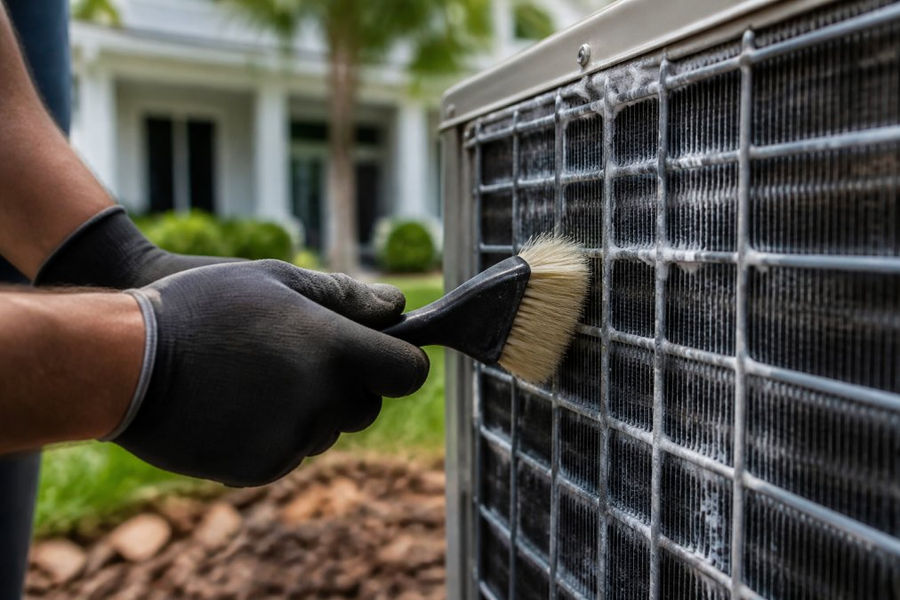
Monthly filter changes are essential in coastal areas. Use high-efficiency filters (MERV 11-13) to capture smaller particles before they reach the coil. Quarterly coil cleaning removes salt residue, dust, and debris from the outdoor condenser coil, preventing salt buildup from accelerating corrosion.
Refrigerant levels require checking twice yearly. Salt spray and wind stress can cause micro-leaks in refrigerant lines, forcing the compressor to work harder and consume excess electricity.
Pro Tip Schedule maintenance in spring before peak cooling season and again in fall. This timing catches problems before they become emergencies and ensures peak efficiency when cooling demand is highest.
Ductwork inspection is important for central air systems. Salt spray can corrode ductwork seams, causing conditioned air to escape. Sealing ductwork reduces energy waste and improves system efficiency by 10-15% (energy.gov).
Key Factors: Load Calculations and System Sizing
System sizing is where most HVAC mistakes occur. An oversized unit cycles rapidly, never running long enough to remove humidity effectively. An undersized system runs constantly, consuming excess energy. Proper sizing requires a Manual J load calculation, accounting for insulation levels, window size and orientation, air leakage, occupancy patterns, and local climate data.
Many contractors skip Manual J or perform it superficially, defaulting to rough rules like "one ton per 400 square feet." This approach fails for homes with exceptional insulation, large window areas, or unusual layouts. In Florida's climate, precision sizing directly impacts efficiency and comfort.
Ductwork design is equally critical. Undersized ducts restrict airflow, forcing the system to work harder. Poorly sealed ducts allow conditioned air to escape. Before upgrading your HVAC system, consider sealing air leaks and improving insulation, which often reduce required system size by 10-20%, lowering equipment and installation costs.
Variable-speed compressors tolerate slight oversizing better than single-stage systems because they modulate output to match actual demand. Air Express HVAC LLC performs Manual J calculations for every installation, ensuring precise sizing for your home's specific characteristics.
Conclusion
Choosing the best HVAC systems for Florida homes requires balancing efficiency, durability, and cost against your specific climate challenges. Coastal homeowners must prioritize corrosion-resistant coils and variable-speed compressors that manage humidity effectively. All Florida homeowners benefit from systems engineered for high SEER2 ratings and equipped with smart controls.
Air Express HVAC LLC specializes in installing, maintaining, and servicing all HVAC systems throughout Southwest Florida. Our team performs Manual J load calculations to ensure precise sizing, handles quarterly coastal maintenance to extend system life, and backs every installation with our 10-year worry-free parts and labor guarantee. Whether you're upgrading to a high-efficiency variable-speed system or maintaining your current equipment, we're available 24/7 to keep your home comfortable year-round. Give us a call to discuss your HVAC needs and get a professional assessment of your home's specific requirements.
Frequently Asked Questions
Q: What is the best HVAC system for Florida homes?
A: The best HVAC system for Florida depends on your budget and priorities. Carrier Infinity 26 and Lennox XC25 lead in energy efficiency with up to 26 SEER2 ratings, ideal for maximizing savings. Trane XV20i and Rheem Prestige RP20 offer excellent humidity control and variable-speed compressors essential for Florida's climate. For tight spaces, Daikin Fit systems excel. For budget-conscious buyers, Goodman GSXC18 delivers solid performance. All top systems feature corrosion-resistant components and Energy Star certification. Consult a local HVAC professional to perform a Manual J load calculation for your specific home.
Q: How do high SEER2 ratings impact cooling costs?
A: SEER2 measures air conditioning efficiency under realistic conditions. Higher SEER2 ratings mean lower energy consumption and reduced utility bills. A 26 SEER2 system uses roughly 30% less energy than a 17 SEER2 unit. In Florida's hot climate with year-round cooling demands, this translates to hundreds of dollars in annual savings. Variable-speed compressors in high-efficiency systems also improve humidity control, reducing the workload on your system. The higher upfront cost typically pays back through energy savings within 5-8 years, especially with available tax credits and rebates.
Q: What makes HVAC coils corrosion-resistant in coastal areas?
A: Coastal salt air accelerates corrosion. Leading manufacturers use zinc cladding, welded aluminum, and epoxy-coated components to resist salt exposure. Lennox XC25 features an all-aluminum Quantum coil engineered for salt air. Carrier Infinity 26 uses heavy-gauge copper tubing with protective coatings. Trane XV20i employs welded aluminum construction. These materials prevent refrigerant leaks and extend system lifespan in harsh coastal environments. Standard steel components rust quickly near saltwater. When selecting a system, verify the coil construction and corrosion warranty. Many premium systems offer extended warranties specifically for coastal installations.
Q: What does HVAC maintenance for coastal homes require?
A: Coastal HVAC maintenance differs from inland routines. Schedule professional inspections every 6 months instead of annually to catch salt corrosion early. Have technicians clean condenser coils monthly during cooling season to remove salt deposits and prevent efficiency loss. Check refrigerant levels frequently, as salt-induced leaks occur faster. Inspect outdoor unit cabinets for rust and apply protective coatings as needed. Ensure proper thermostat calibration and verify blower motor operation. Replace air filters every 30-45 days in coastal areas due to salt-laden air. Professional maintenance extends system life by 3-5 years and maintains efficiency ratings. Air Express HVAC provides specialized coastal maintenance programs for residential and commercial properties.
Q: Should I choose a heat pump or air conditioner for Florida?
A: Heat pumps offer advantages in Florida despite the state's minimal heating needs. Variable-speed heat pumps like Trane XV20i and Rheem Prestige RP20 provide superior humidity control and dehumidification year-round, crucial for Florida's climate. They deliver efficient cooling in summer and low-cost supplemental heating on rare cold days. Traditional air conditioners excel purely in cooling but lack heating capability. Heat pumps typically cost more upfront but deliver better humidity management and lower operating costs. If heating is unnecessary, high-efficiency air conditioners like Carrier Infinity 26 or Lennox XC25 maximize cooling performance and savings. Consider your home's thermal envelope, existing ductwork, and comfort priorities when deciding.
GIVE US A CALL
This article was written using GrandRanker


Comments