Emergency AC Repair Cost 2026: What to Expect

Table of Contents
What Emergency AC Repair Actually Costs
Common AC Problems and Their Repair Costs
After-Hours HVAC Service Fees and When They Apply
Central AC vs Ductless Mini Split Emergency Repair
Repair vs Replacement: The $5,000 Rule
How to Avoid Inflated Emergency Repair Costs
Financing and Warranty Options for Emergency Repairs
Frequently Asked Questions
Last Updated: September 25, 2026
What Emergency AC Repair Actually Costs
When your air conditioning fails, the first question is "how much will this cost?" Emergency AC repair cost varies dramatically depending on what's broken, when you need it fixed, and where you live. At Air Express HVAC LLC, we handle emergency calls around the clock. Repair costs vary depending on the specific issue, required parts, and labor.
Emergency pricing includes the service call fee, diagnostic fee, and repair labor plus parts. Timing matters significantly, as after-hours or weekend service may incur additional charges. Understanding these layers prevents sticker shock.
Licensed professionals from reputable companies charge differently than unlicensed operators, directly affecting whether you get a fair repair or inflated pricing.
Common AC Problems and Their Repair Costs
The problem determines most of your final bill. A refrigerant leak costs far less than compressor failure, which costs less than condenser replacement. Knowing what typically breaks helps you ask the right questions.
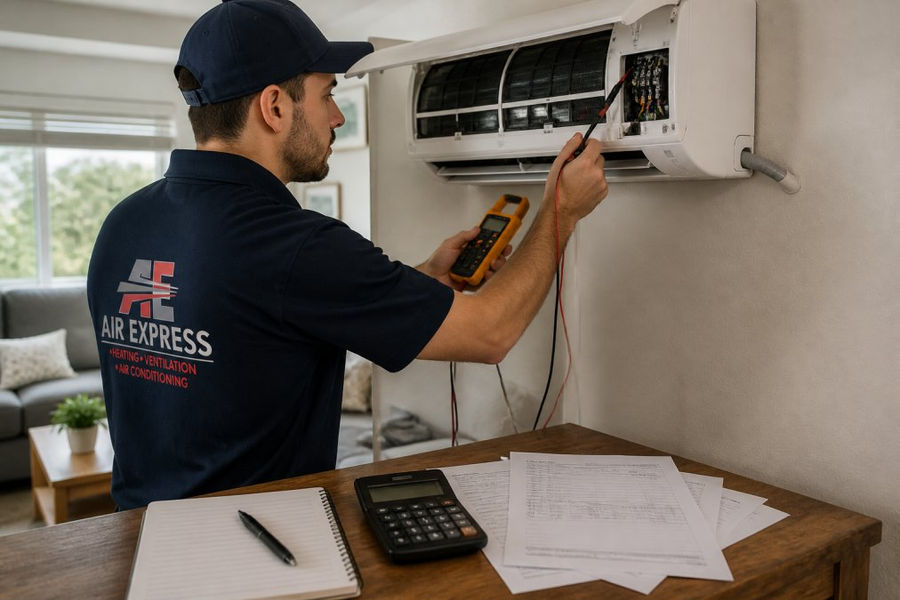
Refrigerant leaks are common emergency calls. The repair involves locating the leak, sealing it, and recharging the system, typically less expensive than other repairs since major components don't need replacement. However, leaks in the evaporator coil require full coil replacement, which costs significantly more.
Fan motor failure prevents cool air circulation even when the compressor runs fine. Replacing a fan motor is straightforward and less expensive than compressor work, though labor costs rise for after-hours or holiday service.
Compressor failure is the most expensive emergency repair. Once it fails, costs jump significantly because the part is expensive and installation is labor-intensive. Technicians often recommend replacement over repair, especially for systems over 10 years old.
Drain line clogs cause water backup and safety shutoffs. Clearing the line is cheap, but water damage to circuit boards escalates costs quickly. Regular cleaning prevents this issue.
Thermostat issues sometimes masquerade as AC failure. If your thermostat isn't communicating with the system, your AC won't turn on even if everything else works fine. Replacing a thermostat costs far less than replacing a compressor, but you won't know which problem you have without a diagnostic.
After-Hours HVAC Service Fees and When They Apply
Emergency AC repair cost calculations change dramatically based on when you call. A repair at 2 PM on Tuesday costs less than the same repair at 2 AM on Saturday. Understanding when surcharges apply helps you decide whether to wait for business hours or pay premium rates.
Most HVAC companies charge a base service call fee to diagnose the problem. After-hours surcharges stack on top of this fee. Weekend rates typically run 50 to 100 percent higher than weekday rates, with holiday surcharges even steeper.
After-hours surcharges reflect premium technician pay, tighter scheduling, and lower call volume. A 24/7 operation like Air Express HVAC LLC maintains round-the-clock staffing, which costs significantly more than standard business hours.
Some companies offer lower after-hours rates for maintenance contract customers, incentivizing preventative maintenance and rewarding loyalty. Ask about this when you call.
If your AC fails on a Friday and the issue is uncomfortable but not dangerous, waiting until business hours might save on after-hours surcharges. But during heat waves or unsafe conditions, emergency AC repair cost is the price of safety.
Central AC vs Ductless Mini Split Emergency Repair
The type of system you have determines both the repair process and the cost structure. Central AC systems and ductless mini splits fail differently, require different parts, and involve different labor.
Central AC systems use ducts to distribute cool air. The outdoor condenser houses the compressor; the indoor air handler manages distribution. Ductwork issues are particularly expensive because repairs often require opening walls or ceilings. Refrigerant leaks in ductwork are harder to locate, driving up diagnostic time and labor costs.
Ductless mini split systems use wall-mounted units connected to an outdoor compressor. Repairs are often simpler because technicians can isolate individual zones and troubleshoot faster. If one indoor unit fails, others keep working. Ductless systems have fewer components, making parts replacement more straightforward.
Central AC repairs often cost more due to ductwork complexity. Ductless systems are cheaper to repair because they're modular with fewer connection points. However, parts availability and technician familiarity vary by region, affecting costs.
The supporting keyword "central AC vs ductless mini split emergency repair" matters here because the choice between systems affects long-term emergency costs. If you're considering a new system and emergency repair costs concern you, ductless mini splits offer simpler repairs and faster diagnostics, though central AC is still the standard in most homes.
Repair vs Replacement: The $5,000 Rule
At some point, repairing an old AC system stops making financial sense. The question isn't whether the repair works, it's whether you're throwing good money after bad. The $5,000 rule is a useful heuristic: if your repair cost approaches or exceeds 50 percent of a new system's price, replacement is usually the better choice.
Here's the logic: if your compressor fails and the repair costs a significant portion of a new system's price, you're halfway to a new system. If your system is 12 years old or older, the next failure is coming soon. You could end up spending a substantial amount on subsequent emergency repairs within a few years. At that point, you could have paid for a new system twice over and still have an old one.
The decision also depends on your system's age. AC systems typically last 15 to 20 years with proper maintenance. If yours is 10 years old and the compressor fails, replacement makes sense because you'll get another 10 to 15 years of reliable service. If it's 18 years old and something major breaks, replacement is almost always the right call. Older systems are also less efficient, so a new system will lower your energy bills, offsetting some of the replacement cost over time.
One factor many homeowners overlook: repair warranties versus replacement warranties. A repair might come with a one-year parts warranty. A new system typically includes a 5 to 10-year parts and labor warranty, and Air Express HVAC LLC offers a 10-year worry-free parts and labor guarantee on new installations, which gives you real peace of mind. That warranty difference is worth factoring into your decision.
The emergency AC repair cost situation changes your timeline. If you're already spending emergency rates and surcharges, that's a signal your system is failing. Budget for replacement sooner rather than later, and you'll avoid the cycle of expensive emergency repairs.
How to Avoid Inflated Emergency Repair Costs
The best way to manage emergency AC repair cost is to prevent emergencies in the first place. Preventative maintenance catches problems before they become catastrophic failures. A clogged filter, low refrigerant, or failing capacitor can be addressed during a routine service call for far less than an emergency repair.
Schedule annual maintenance before summer heat arrives. A technician will clean coils, check refrigerant levels, test electrical connections, and inspect the compressor. This costs far less than an emergency call and prevents most common failures. Many companies offer maintenance plans that bundle regular service with discounted emergency rates for customers on the plan, a benefit worth pursuing.
Know your system's age and condition. If your AC is past 12 years old, budget for replacement rather than investing in major repairs. If it's newer, repairs are usually worth the cost. Keep your documentation showing what's been serviced and repaired. This helps technicians understand your system's history and make better recommendations.
Troubleshoot simple issues yourself before calling. If your AC isn't cooling, check whether the thermostat is set to cool mode and the temperature is set lower than the current room temperature. Check your air filter, a clogged filter is a common culprit and costs nothing to replace. Check the outdoor unit to make sure it's not blocked by debris. These basic checks take five minutes and often solve the problem without a service call.
Get multiple estimates for major repairs. When a technician recommends a major repair, get a second opinion. Different technicians might diagnose the same problem differently, and estimates can vary. This is especially important for compressor replacement or condenser unit work, where costs are high and the stakes matter.
Ask about financing options. Many HVAC companies offer payment plans or financing for repairs and replacements. If you're facing a significant emergency repair, spreading payments over time makes it manageable.
Financing and Warranty Options for Emergency Repairs
When an emergency repair bill arrives, few homeowners have cash ready. Understanding your financing and warranty options means you're not caught off guard.
Frequently Asked Questions
How much does emergency AC repair cost?
Emergency AC repair cost depends on the specific problem, your system type, and the time of day you need service. A diagnostic fee typically applies upfront, then parts and labor costs vary. Refrigerant leaks, compressor failures, and circuit board replacements represent the most expensive repairs. After-hours service adds a surcharge on top of standard labor rates. Contact Air Express HVAC LLC for a detailed estimate based on your system's needs.
What is the $5,000 AC rule for repairs versus replacement?
The $5,000 rule is a decision framework: if the cost of a repair approaches or exceeds 50 percent of a new system's price, replacement often makes more financial sense than repair. For example, if your system is 10 years old and the repair cost is a significant portion of a new system, it might exceed the threshold. Systems over 15 years old typically have lower efficiency and higher failure risk, making replacement more cost-effective long-term despite higher upfront expense.
What factors influence emergency AC repair pricing?
Key factors include the type of problem (refrigerant leak vs compressor failure), your system's age and brand, whether the repair happens during standard business hours or after-hours, geographic location, and parts availability. Licensed HVAC technicians charge for diagnostic time, labor, and replacement parts. Emergency dispatch fees and weekend or holiday surcharges also apply when service is needed outside normal hours. Preventative maintenance reduces emergency repair frequency and costs.
How can I avoid paying inflated emergency AC repair fees?
Schedule preventative maintenance to catch problems before they become emergencies. Learn basic troubleshooting: check your thermostat settings, inspect the drain line for clogs, and verify the circuit breaker is on. When you do need emergency service, get a detailed estimate and ask what's included in the service call fee. Request references and verify the technician is licensed and insured. Avoid companies that pressure you toward replacement without explaining why repair isn't viable. Air Express HVAC's 10-year worry-free parts and labor guarantee protects your investment.
GIVE US A CALL
Comments